Underland
Bride of AlvarUnderland is the southernmost country in Axus and Alvar’s kingdom, a realm whose survival depends on the unstable boundary between Earth and the wider Axian world. Lucy first encounters it as both beautiful and strange, but its splendor is inseparable from political danger: her arrival is meant to secure peace, while rival powers still contest Alvar’s rule and threaten to reopen the route between worlds.
Definition and Setting
Underland is presented to Lucy as a kingdom rather than merely a distant country. Alvar welcomes her into the land over which he rules and tells her that, as his queen, she will become the mother of its future. The setting therefore joins landscape, monarchy, and reproductive expectation in a single image: Underland is a place Lucy is expected not only to enter but also to perpetuate through marriage and children.
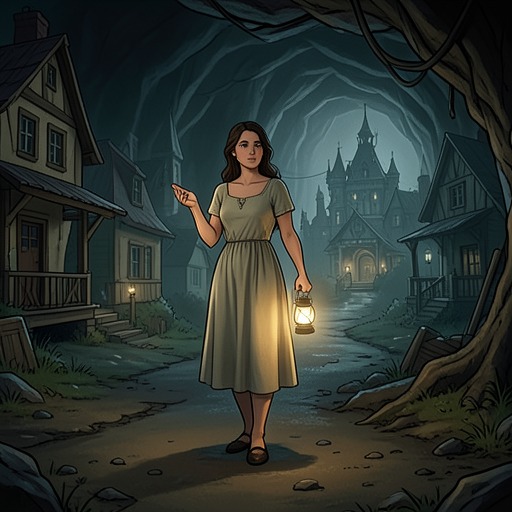
Lucy’s first response is wonder. The country differs from Earth in its atmosphere and sensory character, with lighter air, fragrant spices, morning dew, and two moons, the lavender Arlith and the white Vesp. Yet the welcome is interrupted by the memory of Emily’s screams and by the question of who sought to abduct them. Underland’s beauty is consequently established beside threat from the beginning; it is not an untouched fantasy refuge but a realm whose political conflicts reach directly into Lucy’s experience.
Treaty, Monarchy, and Cross-World Power
Underland’s relationship with Earth is formalized through an agreement made under oath to Elias, dated October 10, 1993 on Earth and the twenty-third day of Havath, 2918 on Axus. Hannah Delaney promised the female child she carried to King Alvar as his future wife and queen, with the marriage intended to secure peace between Earth and the realms of Axus. Once the girl came of age, Alvar was entitled to bring Hannah and her daughter to Underland, where Underland would provide their material and personal needs, protection by the Underland Guard, and instruction from the Institute of Underland in local customs.
The treaty makes Underland a political destination before it becomes Lucy’s home. Her person is treated as the living guarantee of an interworld settlement, and her future marriage is made to bear diplomatic consequences for two realms. That arrangement conflicts sharply with Lucy’s initial plan for a quiet life on Earth with Mike Jones. Mike represents stability and a fresh start, while Underland represents a past arranged before Lucy could consent to it. The kingdom’s claim on her therefore operates through law, inheritance, and diplomacy as much as through Alvar’s personal authority.
Alvar later explains that the treaty was also designed as a safeguard against Saul’s return. After having Saul arrested by Earth authorities, Alvar feared that the tyrant’s sentence would eventually end. He arranged for the dying infant Lucy to receive his blood, knowing that she would be an adult by the time Saul could return, and planned to marry her so that a treaty would cut Axus off from Earth. Underland thus stands at the center of a defensive strategy: Lucy’s existence and marriage were intended to make the bridge between worlds politically unusable to a returning tyrant.
Internal Conflict and Threats to Rule
Underland is not politically stable even after Alvar has saved it and much of Axus. Fletch explains that some people in Axus still challenge Alvar and attempt to provoke disorder in pursuit of power. Maggort is identified as one of these opponents. He favors the old ways of Underland during dark times, a system described as selfish, ruthless, immoral, and built on the backs of slaves, with Saul as its model.
The kingdom’s conflict is also expressed through its treatment of lawbreakers and enemies. Alvar tells Lucy that the gobli custom of execution uses a Star Wheel, where criminals are torn apart limb by limb before being beheaded. His detached description unsettles Lucy and makes the violence embedded in the surrounding political order visible. Underland is not governed by a single moral or legal culture: its customs exist beside the practices of Goblia, the authority of kings, religious oaths, and the competing claims of different peoples within Axus.
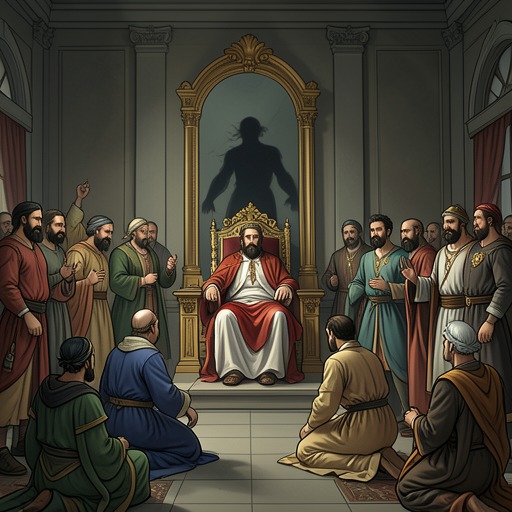
The crisis becomes more severe when Alvar reveals publicly that he is a Cursed. Lord Calbir recounts that Saul once placed a Fe collar on Calbir’s daughter and that, after her release from Saul’s harem, the destruction of her will left her unable to recover; she killed herself three months later. Another nobleman argues that Alvar, as a Cursed, has no right to rule and accuses him of terrorizing the population while concealing his true form. These reactions show Underland struggling not only with military danger but also with inherited stigma, competing definitions of legitimacy, and the political uses of fear.
Alvar’s Sacrifice and Underland’s Survival
When Alvar warns that Saul is returning, Lord Calbir asks for permission to destroy him. Alvar grants it without resistance, raises Calbir, and gives him his weapon as a symbol of transferred command. He instructs Calbir to lead the army against him, seek safety, conceal its location, and prepare for battle. The king’s act converts personal sovereignty into a temporary public trust: he accepts that his own body may have to be destroyed to prevent Saul from using it as an instrument of renewed tyranny.
Underland’s fate is ultimately tied to the defeat of Saul. After a violent confrontation, Lucy sees the burnt remains of a body and confirms that Saul is dead. The immediate consequence is relief that the threat has ended, while Alvar’s exhausted response emphasizes how completely the struggle has consumed the kingdom and its ruler. Underland survives not through the unquestioned continuity of monarchy but through the destruction of the tyrant who had shaped its recent history.
The aftermath continues to expose the kingdom’s need for institutional justice. When Lord Vessin is taken away by guards after attempting to violate Lucy, she finds the punishment less important than the restoration of her safety beside Alvar. The scene places Underland’s guards in the role of enforcing a boundary that power had threatened to erase: even within a royal setting, coercion against Lucy must be answered by confinement.
Narrative Significance
Underland functions as the novel’s central threshold between private life and political history. Lucy’s wish for a stable marriage with Mike Jones is contrasted with a kingdom that demands her participation in diplomacy, queenship, and possible motherhood. Her resistance to intimacy with Mike reveals that the Earth life she imagined is already inadequate to her emotional reality, yet her attraction to Alvar does not erase the coercive structure that brought her to Underland.
The kingdom also embodies the book’s recurring contrast between arrangements made for survival and relationships that acquire genuine feeling. Alvar initially describes marriage as a practical arrangement and offers Lucy wealth, power, and material security, while Lucy experiences the prospect as an assault on her freedom. Later, his willingness to abandon offspring and succession if that would make her free reveals the cost he is prepared to bear for her happiness. Underland therefore changes in meaning as Lucy’s understanding changes: it begins as a realm claiming her through an inherited treaty and becomes the place where political duty, personal desire, violence, and the possibility of chosen belonging converge.